
Executive Summary of Regional Baseline Study on Green Hydrogen launched at Green Hydrogen Symposium
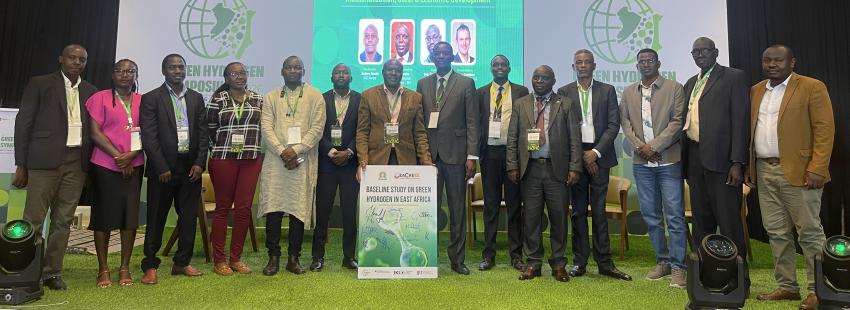
The East African Community region has significant renewable energy potential; in partnership with GIZ, EACREEE laid the foundation for assessing the region’s readiness and identifying opportunities to advance green hydrogen and Power-to-X development. If this potential is fully harnessed, partner states are in a position to reduce their reliance on fossil fuels in heavy industry, the maritime and aviation sectors, and strengthen trade, tourism and food security.
On 21st May 2026 in Nairobi, Kenya, the Executive Summary of the Baseline Study on Green Hydrogen in Eastern Africa was launched at the fourth edition of the Green Hydrogen Symposium. The Baseline Study on Green Hydrogen is expected to support partner states in aligning their efforts and prioritising investment locations for green hydrogen production.
Speaking at the launch ceremony, the Civil Aviation Principal Officer, Mr Paul Christian Rwegasha from the East African Community Secretariat, underscored the significance of the Regional Baseline Study
“The Baseline Study provides an important foundation for developing regional green hydrogen strategy and roadmaps. It will help attract public and private investments into clean energy infrastructure, strengthen policy harmonisation and regulatory alignment, build capacity, promote research, innovation and technology transfer and position the East African Community as a competitive player in the global green hydrogen market,” he said.
Mr Paul Rwegasha reaffirmed that green hydrogen not only represents a climate solution but also a transformative economic opportunity for the EAC.
The Baseline Study on Green Hydrogen in Eastern Africa also identifies significant gaps in technical expertise and institutional capacity among stakeholders across the region, despite strong policy interest and emerging pilot initiatives.
EACREEE, under the Promotion of Green Hydrogen in Eastern Africa Project funded by GIZ through the H2-Diplo Project, conducted a two-day regional technical training on green hydrogen and power-to-X. The training brought together representatives from ministries responsible for energy in 8 EAC partner states and the East African Community Secretariat. The representatives were trained in production technologies (Electrolysis and Infrastructure Requirements), renewable energy and water considerations, sector-specific use cases (Industry, Transport, Power, Fuels), institutional frameworks, market development, sustainability criteria and environmental considerations, among others, to support informed planning, the development of regulatory frameworks, and the early deployment of green hydrogen and power-to-X in the East African Community. While speaking at the training kick-off, the Executive Director of EACREEE, Canon Goddy Muhanguzi Muhumuza, reaffirmed EACREEE’s commitment to supporting partner states in strengthening the region's technical and institutional capacities to advance a just and inclusive energy transition. He emphasised that capacity development remains a priority in EACREEE’s journey to build a sustainable future for the region through the promotion of renewable energy and energy efficiency.


EELA E-Learning Platform
EACREEE newsletter
Updates from our latest news!